
Overview
I led end-to-end research examining how effectively the Uber Rider app supports riders during complex pickup experiences. As project manager, I coordinated all research phases, from study design and recruitment through analysis and final delivery, while staying hands-on in every step: screening participants, facilitating interviews, logging behavioral data, and building the affinity map.
Overview
I led end-to-end research examining how effectively the Uber Rider app supports riders during complex pickup experiences. As project manager, I coordinated all research phases, from study design and recruitment through analysis and final delivery, while staying hands-on in every step: screening participants, facilitating interviews, logging behavioral data, and building the affinity map.
Process
Process
Define Research Questions
I worked with the team to narrow the focus from "the pickup experience" to a specific slice: what happens when pickup goes wrong, and why.
We scoped the study around four core research questions:
How well do riders understand where to go for pickup?
How do riders navigate to confusing or complex pickup locations?
How effectively do riders coordinate with their driver during the rendezvous?
Do riders feel they have sufficient information to complete the pickup?
We intentionally targeted complex pickup environments, where coordination failures are most likely to surface.
I worked with the team to narrow the focus from "the pickup experience" to a specific slice: what happens when pickup goes wrong, and why.
We scoped the study around four core research questions:
How well do riders understand where to go for pickup?
How do riders navigate to confusing or complex pickup locations?
How effectively do riders coordinate with their driver during the rendezvous?
Do riders feel they have sufficient information to complete the pickup?
We intentionally targeted complex pickup environments, where coordination failures are most likely to surface.
I worked with the team to narrow the focus from "the pickup experience" to a specific slice: what happens when pickup goes wrong, and why.
We scoped the study around four core research questions:
How well do riders understand where to go for pickup?
How do riders navigate to confusing or complex pickup locations?
How effectively do riders coordinate with their driver during the rendezvous?
Do riders feel they have sufficient information to complete the pickup?
We intentionally targeted complex pickup environments, where coordination failures are most likely to surface.
Methods
Screening Survey
Screening Survey
Identifying riders most likely to face real pickup challenges
Identifying riders most likely to face real pickup challenges
Distributed via personal networks and relevant communities
Screened for recent confusing pickup experience, Uber usage frequency, and urban environment
Collected demographic info and self-reported app confidence
9 participants were selected out of the respondent pool
Distributed via personal networks and relevant communities
Screened for recent confusing pickup experience, Uber usage frequency, and urban environment
Collected demographic info and self-reported app confidence
9 participants were selected out of the respondent pool
Unmoderated Usability Testing
Unmoderated Usability Testing
Capturing authentic pickup decisions as they happen in the real world
Capturing authentic pickup decisions as they happen in the real world
Participants screen-recorded a real Uber pickup from booking through vehicle entry
Used a think-aloud protocol: narrating what they saw, what they expected, and what confused them
Focused on the rendezvous phase in complex environments (multi-level structures, GPS-unstable zones, one-way streets)
Participants screen-recorded a real Uber pickup from booking through vehicle entry
Used a think-aloud protocol: narrating what they saw, what they expected, and what confused them
Focused on the rendezvous phase in complex environments (multi-level structures, GPS-unstable zones, one-way streets)
Post-test Questionnaire & Interview
Post-test Questionnaire & Interview
Uncovering the reasoning and emotion behind pickup decisions
Uncovering the reasoning and emotion behind pickup decisions
Questionnaire collected quantitative ratings across 6 dimensions (clarity, confidence, trust, reliability, ease of use, and overall satisfaction), each followed by an open-ended "why" to add context to the numbers.
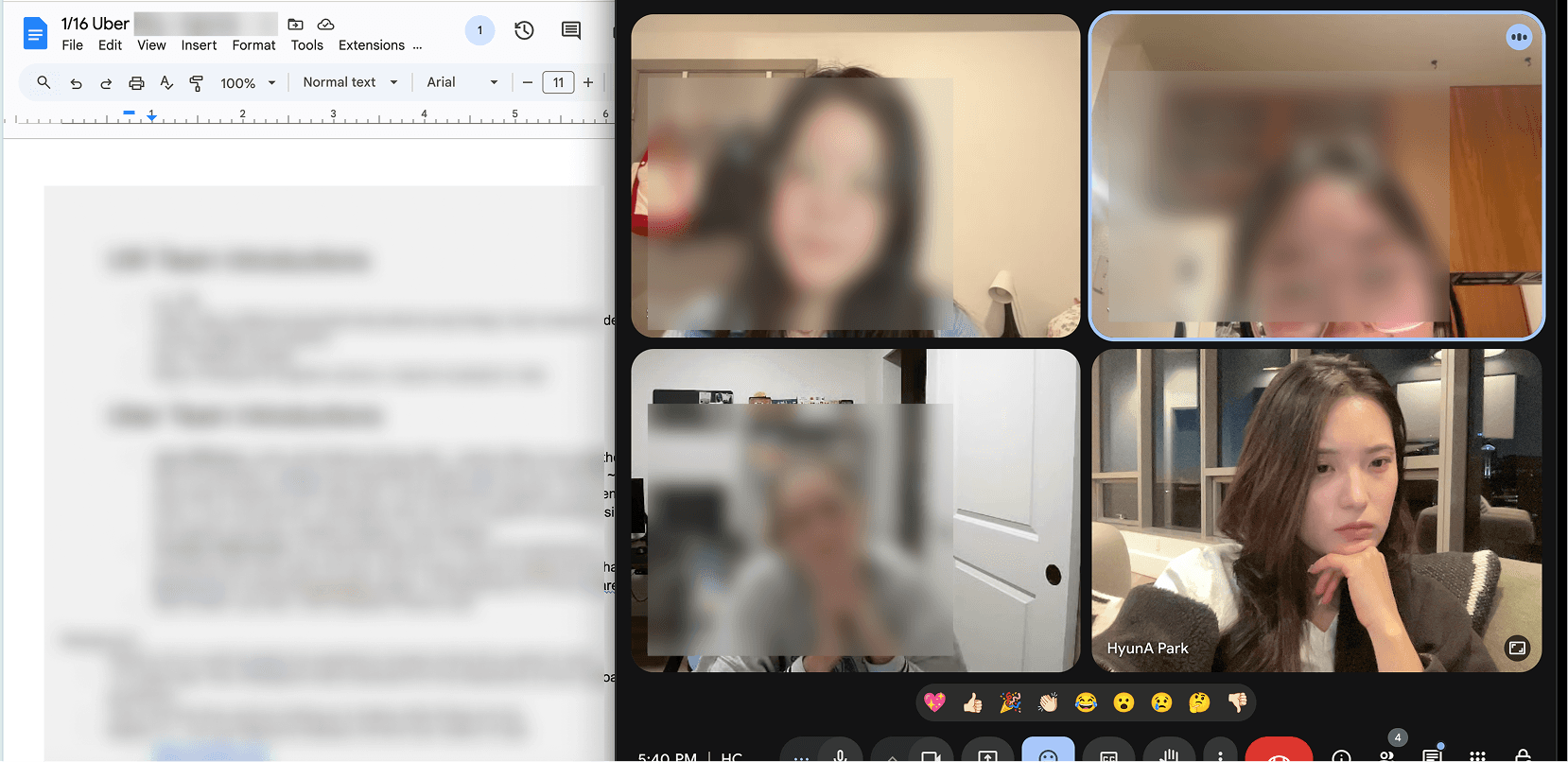
Interview was conducted remotely within a week of each recording, while the experience was still fresh. Questions moved from primary to exploratory, with one goal: explain why riders made the decisions we observed on screen.
Questionnaire collected quantitative ratings across 6 dimensions (clarity, confidence, trust, reliability, ease of use, and overall satisfaction), each followed by an open-ended "why" to add context to the numbers.
Interview was conducted remotely within a week of each recording, while the experience was still fresh. Questions moved from primary to exploratory, with one goal: explain why riders made the decisions we observed on screen.
Research Analysis
Research Analysis
Raw recordings and responses don't speak for themselves. Here's how we turned behavioral observations and survey data into patterns that informed our findings.
Raw recordings and responses don't speak for themselves. Here's how we turned behavioral observations and survey data into patterns that informed our findings.
Data Collection
After receiving each recording, I reviewed it and completed a structured data-logging form before the follow-up interview. This step ensured that interview questions were grounded in what we actually observed, not just what participants remembered.
We logged:
Correct identification of pickup pin location
Map panning, zooming, and pin adjustment behavior
Hesitation indicators (paused actions, prolonged stillness)
Driver coordination actions (messaging, calling)
Time to first corrective action and total pickup duration
Alongside behavioral data, we collected post-test questionnaire responses (6 Likert-scale ratings with open-ended follow-ups) immediately after each ride.
Data Collection
After receiving each recording, I reviewed it and completed a structured data-logging form before the follow-up interview. This step ensured that interview questions were grounded in what we actually observed, not just what participants remembered.
We logged:
Correct identification of pickup pin location
Map panning, zooming, and pin adjustment behavior
Hesitation indicators (paused actions, prolonged stillness)
Driver coordination actions (messaging, calling)
Time to first corrective action and total pickup duration
Alongside behavioral data, we collected post-test questionnaire responses (6 Likert-scale ratings with open-ended follow-ups) immediately after each ride.



Affinity Mapping & Synthesis
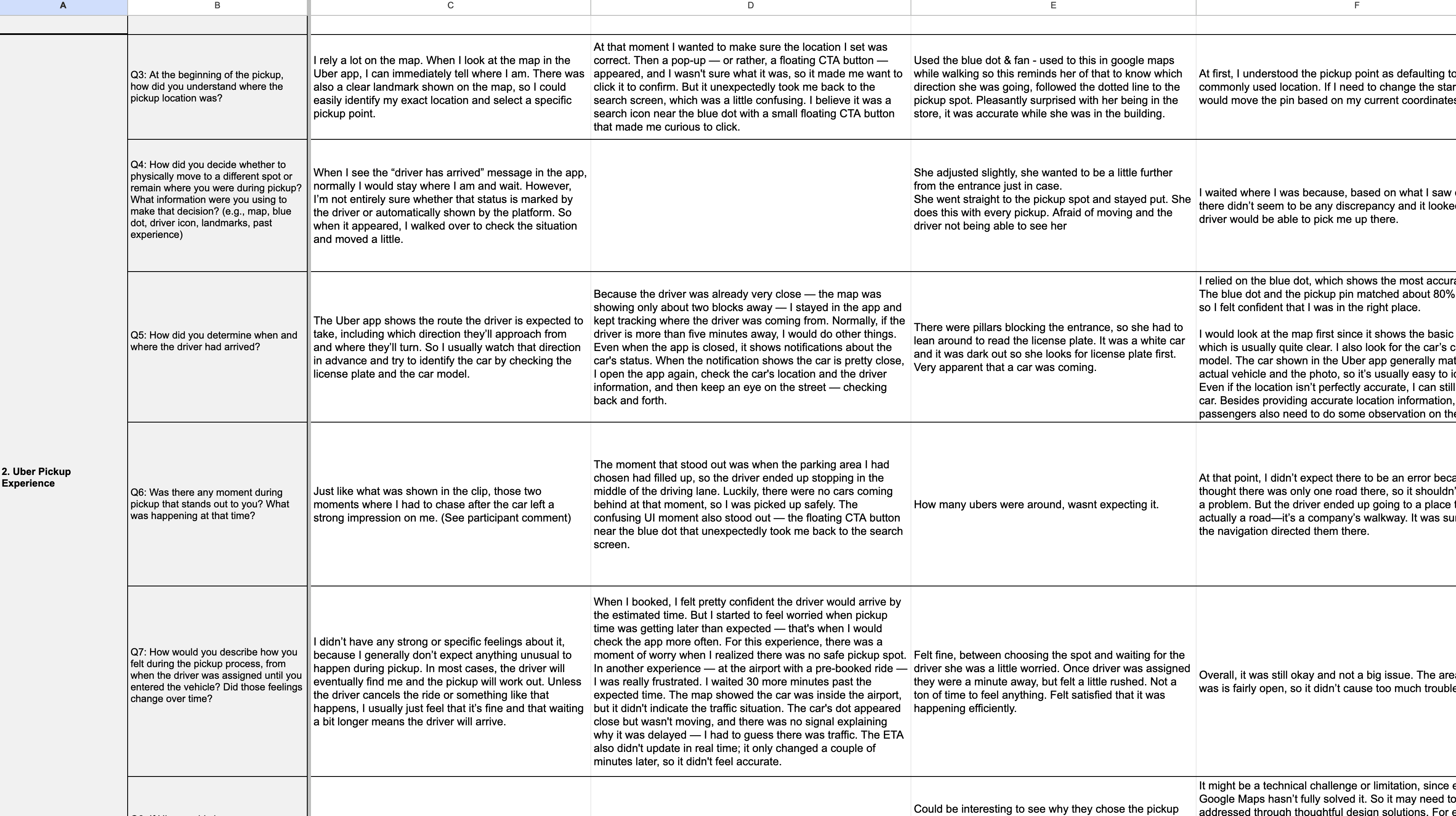
With all data in, we ran a full affinity mapping session to find patterns across participants.
The process:
Tagged and transcribed observations from recordings and interview notes
Clustered observations by behavior and theme, not by assumption
Identified patterns appearing across multiple participants
Cross-referenced qualitative themes against quantitative ratings
One pattern stood out immediately. Several participants rated their satisfaction above average on the questionnaire while verbally expressing frustration during the recording. This gap between what riders said and what they did became one of the most important analytical lenses in the study.
Findings were then organized across three phases of the rendezvous: Setup, Navigation, and Pickup.
Affinity Mapping & Synthesis
With all data in, we ran a full affinity mapping session to find patterns across participants.
The process:
Tagged and transcribed observations from recordings and interview notes
Clustered observations by behavior and theme, not by assumption
Identified patterns appearing across multiple participants
Cross-referenced qualitative themes against quantitative ratings
One pattern stood out immediately. Several participants rated their satisfaction above average on the questionnaire while verbally expressing frustration during the recording. This gap between what riders said and what they did became one of the most important analytical lenses in the study.
Findings were then organized across three phases of the rendezvous: Setup, Navigation, and Pickup.
Findings
We identified 9 usability issues across three phases of the rendezvous. Below are the three most critical findings, prioritized by severity, breadth of evidence, and design implication.
We identified 9 usability issues across three phases of the rendezvous. Below are the three most critical findings, prioritized by severity, breadth of evidence, and design implication.

Street-side ambiguity leads to unsafe behavior
Street-side ambiguity leads to unsafe behavior
The app provides no indication of which side of the road the driver will approach from. Riders were left to guess, wait, or cross busy streets mid-pickup to reach their driver.
4 of 9 participants experienced this directly. More reported it as a recurring issue in interviews.
The app provides no indication of which side of the road the driver will approach from. Riders were left to guess, wait, or cross busy streets mid-pickup to reach their driver.
4 of 9 participants experienced this directly. More reported it as a recurring issue in interviews.
Why this matters: This is the only finding in the study with a direct safety implication. The app communicates where to wait, but not how to safely get there.
Recommendation: Introduce explicit street-side guidance within the pickup map UI, showing which side of the road the driver will stop on before arrival.
Why this matters: This is the only finding in the study with a direct safety implication. The app communicates where to wait, but not how to safely get there.
Recommendation: Introduce explicit street-side guidance within the pickup map UI, showing which side of the road the driver will stop on before arrival.
Riders compensate for vague guidance
Riders compensate for vague guidance
Rather than relying on the app, most participants fell back on personal judgment. They chose familiar or visible spots, stayed put to be found, or walked toward the driver on their own.
Rather than relying on the app, most participants fell back on personal judgment. They chose familiar or visible spots, stayed put to be found, or walked toward the driver on their own.
Why this matters: Riders compensating for the app's gaps is not a user error. It signals a systemic failure. The app provides a pin but no real guidance on how to act on it.
Recommendation: Surface high-success pickup spots, highlight visible landmarks, and provide clearer distance and alignment feedback between rider and driver.
Why this matters: Riders compensating for the app's gaps is not a user error. It signals a systemic failure. The app provides a pin but no real guidance on how to act on it.
Recommendation: Surface high-success pickup spots, highlight visible landmarks, and provide clearer distance and alignment feedback between rider and driver.


Complex environments and driver inconsistency reduce rider confidence
Complex environments and driver inconsistency reduce rider confidence
5 of 9 participants experienced their driver stopping somewhere other than the designated pickup pin. Traffic, parking constraints, and building layouts all contributed. When this happened, the burden of resolving the mismatch fell entirely on the rider.
5 of 9 participants experienced their driver stopping somewhere other than the designated pickup pin. Traffic, parking constraints, and building layouts all contributed. When this happened, the burden of resolving the mismatch fell entirely on the rider.
Why this matters: This finding sits at the intersection of app design and driver behavior. No amount of rider-side UX improvement fully addresses it without also improving how drivers receive pickup guidance.
Recommendation: Suggest pickup points based on real-world stopping feasibility, clarify exact pickup details (entrance, level, side of street), and provide clearer stopping guidance to drivers.
Why this matters: This finding sits at the intersection of app design and driver behavior. No amount of rider-side UX improvement fully addresses it without also improving how drivers receive pickup guidance.
Recommendation: Suggest pickup points based on real-world stopping feasibility, clarify exact pickup details (entrance, level, side of street), and provide clearer stopping guidance to drivers.
Retrospective
Retrospective
"One of the most valuable lessons came from the gap between self-reported satisfaction scores and verbalized frustration in recordings, a reminder that what users say and what they do are not always the same thing. If I were to run this study again, I would prioritize recruiting a more diverse group of participants across age groups and geographic markets. I would also design a parallel study track to capture the driver's perspective, since many of the friction points we identified traced back to coordination breakdowns on both sides. Overall, this study reinforced that the most actionable research findings often come not from what participants report, but from what you observe when they think no one is watching."
"One of the most valuable lessons came from the gap between self-reported satisfaction scores and verbalized frustration in recordings, a reminder that what users say and what they do are not always the same thing. If I were to run this study again, I would prioritize recruiting a more diverse group of participants across age groups and geographic markets. I would also design a parallel study track to capture the driver's perspective, since many of the friction points we identified traced back to coordination breakdowns on both sides. Overall, this study reinforced that the most actionable research findings often come not from what participants report, but from what you observe when they think no one is watching."