Sponsored Course Project
Uber
Developing waiting experience
Challenge
Pickup is where the trip breaks down
Pickup is where an Uber trip is most likely to break down, especially in complex environments: multi-level structures, GPS-unstable zones, one-way streets. Riders and drivers have to coordinate a rendezvous with limited shared context. We narrowed the broad topic of ‘the pickup experience’ to a single question: what happens when pickup goes wrong, and why.
Results
Nine issues across three phases of the rendezvous
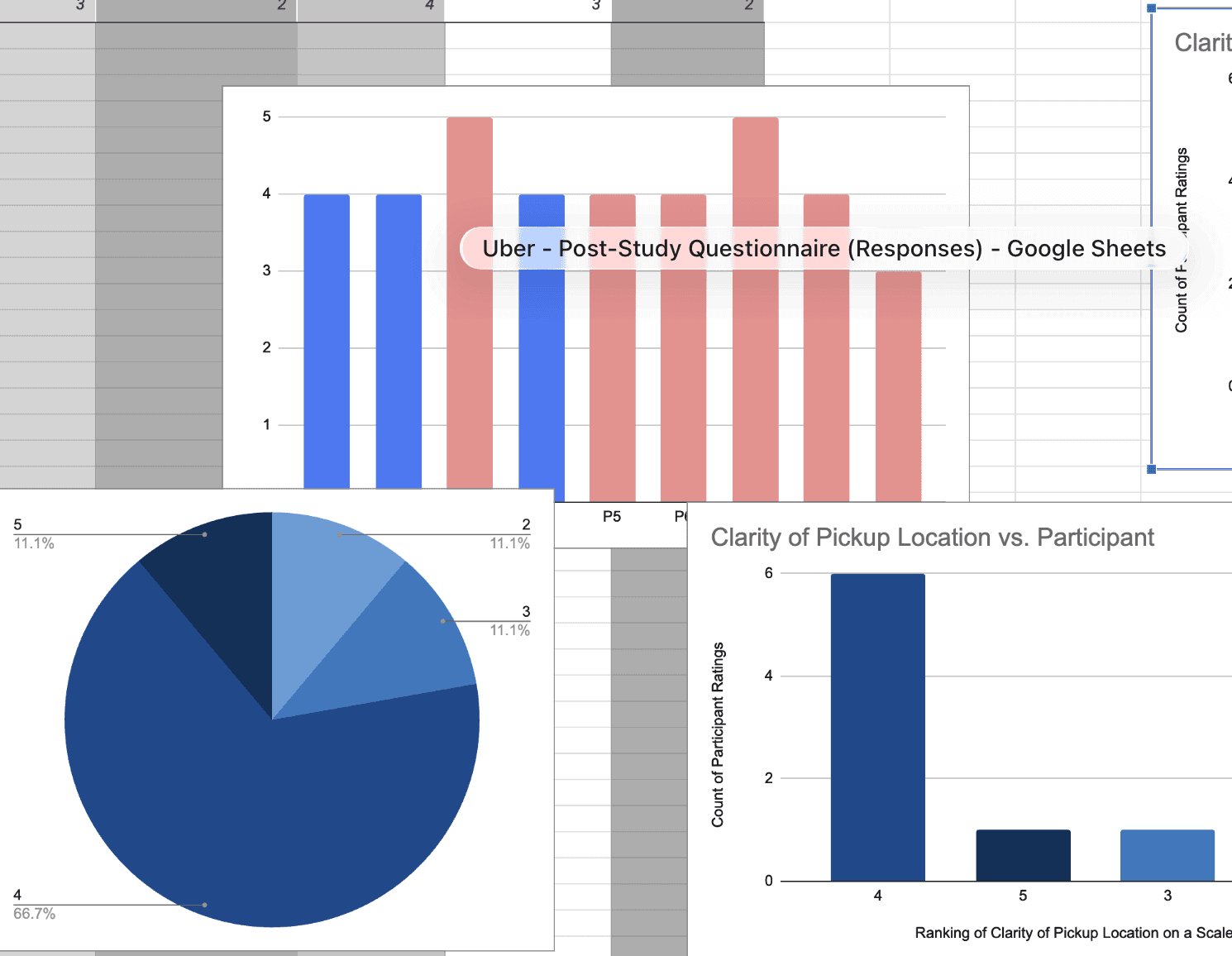
We found 9 usability issues across the three rendezvous phases: Setup, Navigation, and Pickup. Three stood out as the most critical. One pattern shaped the entire analysis. Several participants rated their satisfaction above average on the questionnaire while sounding frustrated in their own recordings. What riders said and what they did were not the same thing.
Process
From research questions to ranked findings
Define Research Questions
With the team, I narrowed ‘the pickup experience’ to a specific slice: what happens when pickup goes wrong, and why. We scoped the study around four questions. How well do riders understand where to go for pickup? How do riders navigate confusing pickup locations? How effectively do riders coordinate with their driver during the rendezvous? Do riders feel they have enough information to complete the pickup? We recruited for complex pickup environments, where coordination is most likely to break down.
Screening Survey
We recruited through personal networks and relevant communities, screening for recent confusing pickup experiences, regular Uber use, and urban environments. We also collected demographics and self-reported app confidence. Nine participants were selected.
Unmoderated Usability Testing
Each participant screen-recorded a real Uber pickup, from booking to getting in the car, thinking aloud throughout: what they saw, what they expected, what confused them. We focused on the rendezvous phase in complex environments.
Post-test Questionnaire and Interview
Immediately after each ride, participants rated six dimensions (clarity, confidence, trust, reliability, ease of use, satisfaction) and explained every rating in their own words. Within a week, I interviewed each participant remotely to understand the reasoning behind the decisions we had observed on screen.
Research Analysis
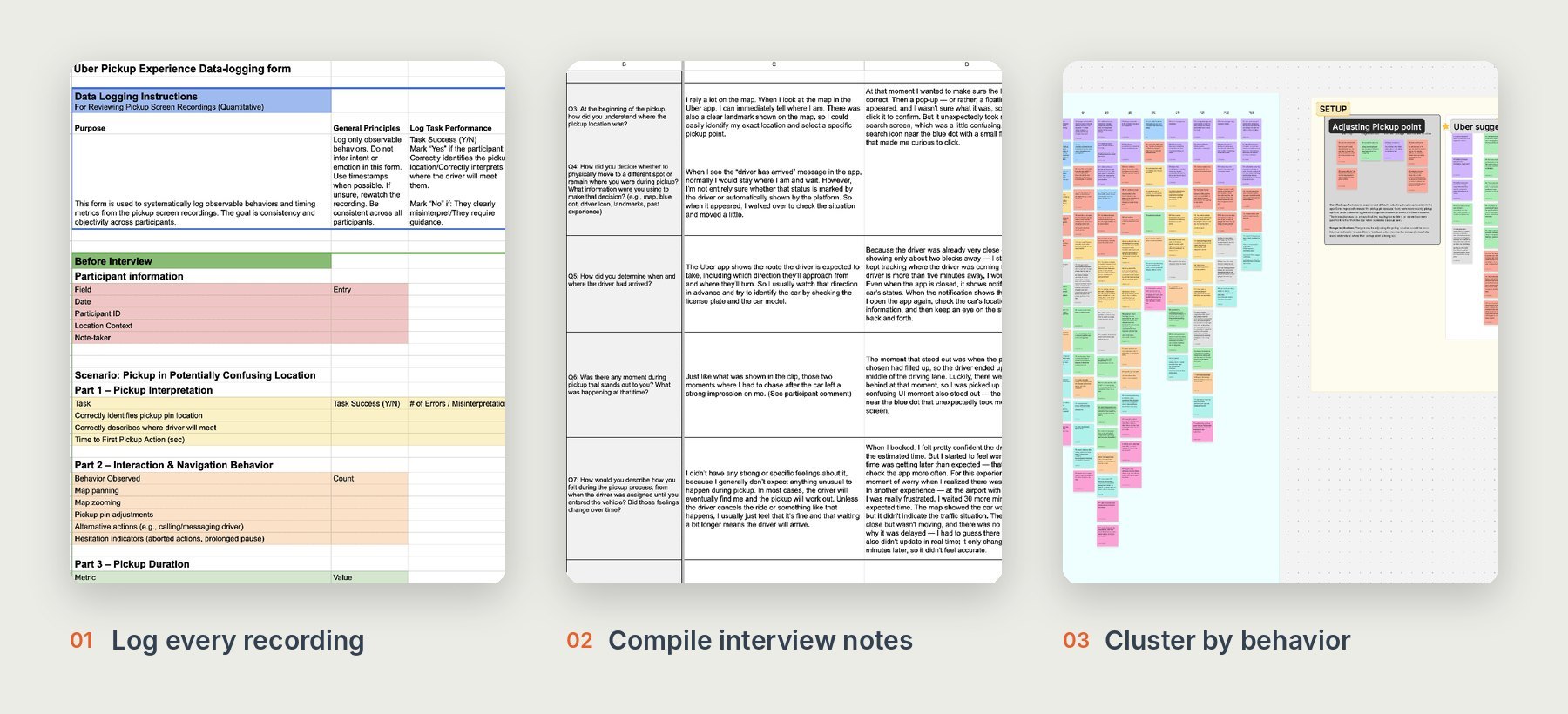
Before each interview, I completed a structured data-logging form for the recording: pin identification, map panning and zooming, hesitation signals, messages or calls to the driver, time to first corrective action. Then we ran a full affinity mapping session. We tagged observations, clustered by behavior rather than assumption, and checked qualitative themes against the quantitative ratings. Findings were organized into Setup, Navigation, and Pickup.
Key findings
Three patterns behind the failed pickups
"…those two moments where I had to chase after the car left a strong impression on me."Participant, post-ride interview
Riders could not tell which side of the street to wait on
The app never indicated which side of the road the driver would approach from. Riders guessed, waited, or crossed busy streets mid-pickup to reach their driver. Four of nine participants ran into this directly, and more described it as a recurring problem.
Why this matters: This was the only finding with a direct safety implication. The app tells you where to wait, but not how to get there safely.
Recommendation: Show explicit street-side guidance in the pickup map before the driver arrives: which side of the road to stand on.
Riders worked around the app instead of with it
Most participants stopped relying on the app and fell back on their own judgment. They picked a familiar or visible spot, stayed put to be found, or walked toward the driver themselves.
"I'm not entirely sure whether that status is marked by the driver or automatically shown by the platform. So when it appeared, I walked over to check the situation and moved a little."Participant, post-ride interview
Why this matters: When riders compensate for the product, that is not user error. It is the product failing. The app drops a pin but offers no guidance on what to do with it.
Recommendation: Surface pickup spots with a track record of working, call out visible landmarks, and show clearer distance and alignment feedback between rider and driver.
Drivers stopped away from the pin, and riders were left to resolve it
Five of nine participants watched their driver stop somewhere other than the designated pin. Traffic, parking constraints, and building layouts all contributed. Resolving the mismatch fell entirely on the rider.
"The moment that stood out was when the parking area I had chosen had filled up, so the driver ended up stopping in the middle of the driving lane."Participant, post-ride interview
Why this matters: This sits at the intersection of app design and driver behavior. Rider-side improvements alone cannot fix it without better guidance for drivers.
Recommendation: Recommend pickup points based on where drivers can actually stop. Spell out the exact details: entrance, level, side of street. And give drivers clearer stopping guidance.
Retrospective
What people said and what they did were not the same
The most valuable lesson came from the gap between satisfaction scores and what we heard on the recordings. What people say and what they do are not always the same thing. If I ran this study again, I would recruit a more diverse sample across age groups and markets, and I would run a parallel track with drivers, since many of the breakdowns came from coordination failing on both sides. The most useful findings came from watching what people did when they thought no one was watching.