Client Project
AI-Driven Ad Compliance Tool
An AI-powered ad compliance tool for a non-profit organization (contents modified under NDA)
Challenge
18,000 ads a year, every review done by hand
The Korea Advertising Review Board (KARB) reviews more than 18,000 advertisements a year. Every review was manual and could take up to an hour per case. The team was spending over 1,500 hours a month on repetitive text analysis, and the delays created a real risk: non-compliant ads reaching the public. No digital system existed for this work in Korea.
Results
Review time went from 60 minutes to 5
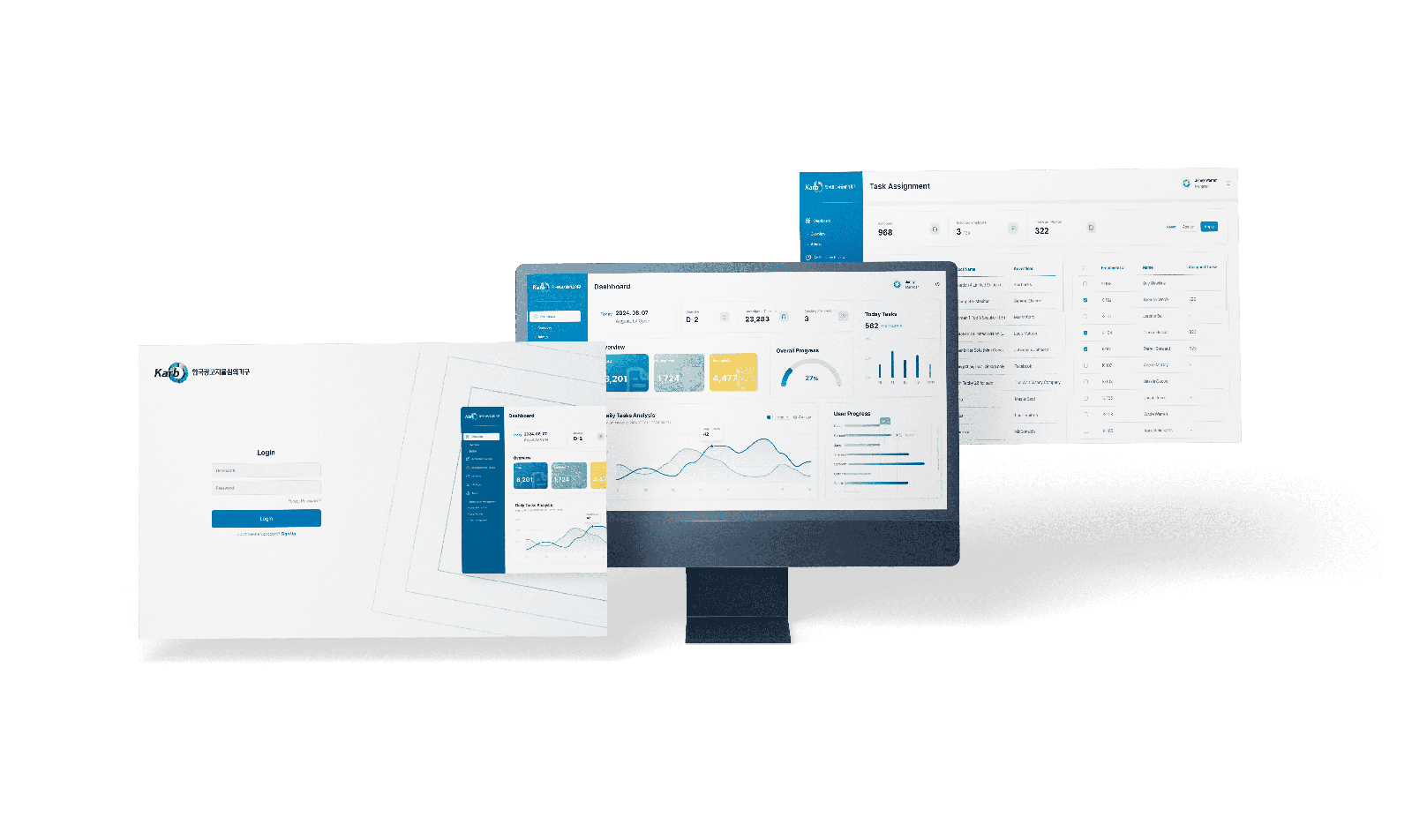
We built an LLM-integrated dashboard that cut review time from 60 minutes to 5 minutes per case, saving more than 16,500 hours a year for the five-person compliance team. Testing showed a 100% task completion rate, 80% user satisfaction, and a 91.7% improvement in workflow efficiency. After launch, the team saved 1,375 hours a month, and the system held up under peak loads of more than 2,000 cases.
My impact
Leading a team of twelve as UX lead
- Led a cross-functional team of 12 as UX Lead and Acting Project Manager, building the system from zero
- Interviewed 9 stakeholders (5 reviewers, 2 managers, 2 administrators) and mapped the regulatory workflow end to end
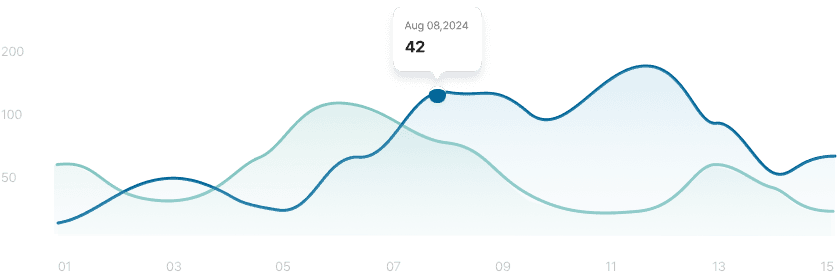
- Designed and validated the LLM dashboard: review time down from 60 to 5 minutes per case, 16,500+ hours saved annually
- Built the design system from scratch: research methods, information architecture, interaction patterns, components, accessibility standards
- Ran iterative testing to 100% task completion, 80% satisfaction, and 91.7% workflow efficiency improvement
Process
From stakeholder interviews to a launched dashboard
Discover the Problem
Structured interviews with 9 stakeholders across 3 user levels showed the bottlenecks went beyond slow manual work. The critical discovery: there was no centralized data system. Reviewers relied on memory to spot similar ads, which meant repeated analysis of identical content, inconsistent decisions on similar cases, and knowledge gaps when experienced staff were away. Management had its own problems: tasks were distributed manually without regard to expertise or workload, and nobody could see progress. The numbers: 1,500 cases a month at 60+ minutes each, zero digital infrastructure, 1,500+ hours a month on repetitive analysis.
Why an LLM
The fix was to turn memory-dependent work into a data-driven process while keeping human oversight, which regulatory work requires. Working with a specialized NLP startup, we used an LLM because it can understand contextual meaning in ad language beyond keyword matching, learn from regulatory precedents for consistency, and control hallucination risk through confidence scoring and human verification loops.
Information Architecture
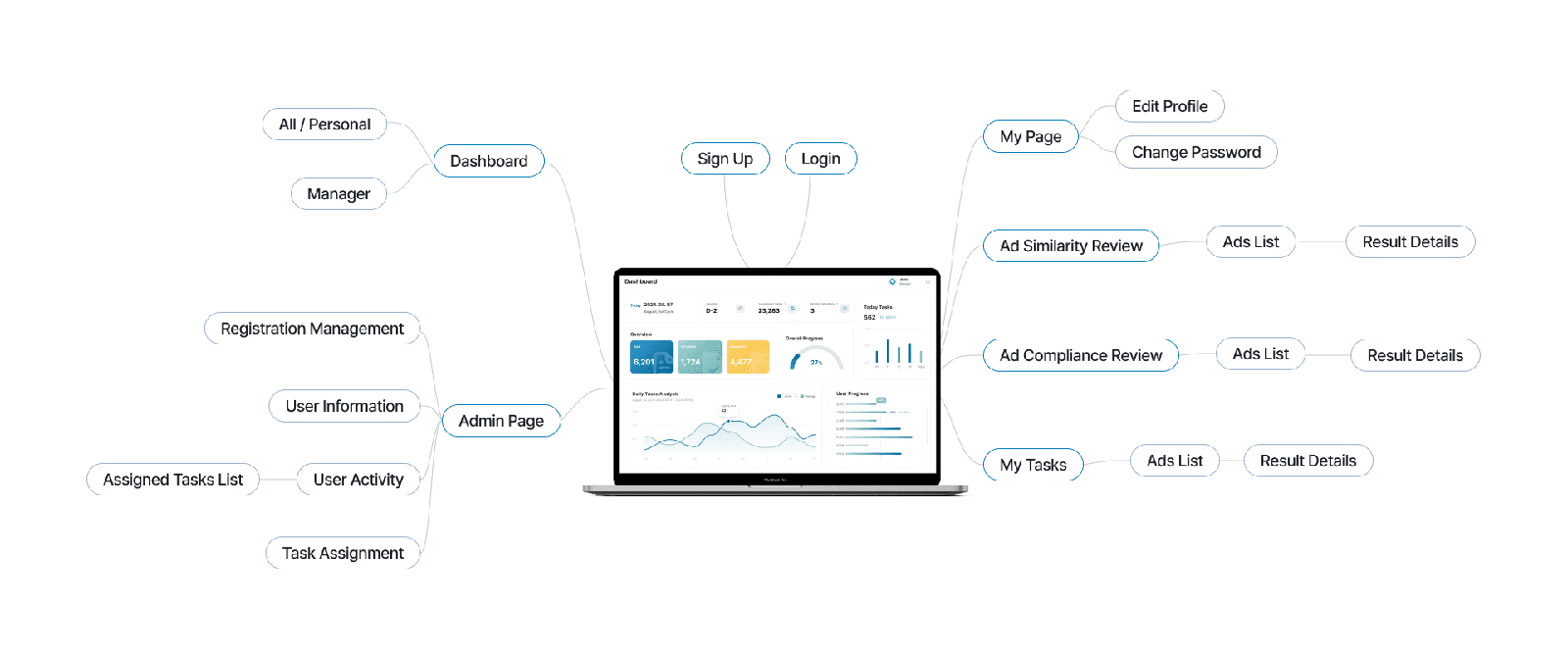
We designed the architecture around four principles. Task-oriented hierarchy: workflows organized around reviewer mental models, not system logic. Progressive disclosure: critical compliance flags up front, detailed analysis on demand. Cognitive load reduction: automate repetitive analysis, keep decision authority with humans. Data visualization priority: turn compliance metrics into visual progress tracking for reviewers and managers.
Design System
There was no precedent for an AI regulatory platform, so I built the design system from scratch within the Korea Design System (KRDS). That meant a typography hierarchy for dense regulatory text that stays readable over long sessions, a color palette meeting government contrast requirements that also separates compliance statuses clearly, iconography for complex regulatory concepts, and a component library covering data visualization, task management, and AI confidence indicators. I worked directly with the front-end and back-end developers on feasibility, responsive specs for desktop-first workflows, and interactive states for AI processing.
Usability Testing
I designed and led remote usability testing in Maze, serving as lead interviewer alongside moderators and note-takers. The hypothesis we tested: could AI assistance cut a 60-minute review to 5 minutes without compromising accuracy? Results: 100% task completion, 80% satisfaction, 91.7% workflow efficiency improvement, 5% error rate. Three usability problems came out of the sessions and were fixed, detailed in the findings below.
After Launch
Post-launch validation: the team went from spending 1,500 hours a month on this work to 125 hours for the same workload. A reviewer told us, “I can actually leave the office on time now.” A team manager said they could see everyone's progress in real time and distribute work more fairly. The system handled peak loads of 2,000+ cases in high-advertising season.
Key findings
What testing with reviewers surfaced
AI confidence scores did not make sense to reviewers
Users struggled to interpret AI confidence scores in a regulatory context. A percentage does not tell a reviewer what to do next.
Why this matters: In compliance work, ambiguity is risk. If reviewers cannot read the AI's certainty at a glance, they either over-check everything or start trusting it blindly.
Recommendation: We redesigned the indicators in familiar regulatory language: “Requires Review” versus “Likely Compliant.”
Managers could not spot urgent cases
In the dashboard view, managers could not quickly identify which cases needed immediate attention.
Why this matters: Deadlines drive compliance work. If urgency is invisible, the cases closest to a deadline get the same attention as routine ones.
Recommendation: We added a color-coded priority system with deadline proximity indicators.
Reviewers could not see their own progress
Reviewers wanted clearer visibility into their daily and weekly completion rates.
Why this matters: People doing high-volume repetitive work need feedback on pace. Without it, they cannot plan their day or see the effect of the new system.
Recommendation: We added a personal productivity dashboard with historical performance trends.
Retrospective
The hard part was trust, not the AI
Government UX is fundamentally different. The hard part was not the AI integration; it was getting people who had worked the same way for years to trust a completely new system. The constraints actually helped: they forced us back to fundamentals instead of trendy patterns, and the 91.7% efficiency gain came from straightforward improvements like better task organization, not flashy features. Building from scratch meant every decision had to be deliberate. Looking back, I wish I had gathered more baseline data upfront, and I would not take on both the UX lead and project management roles again. But the project convinced me that traditional industries adopting AI have real potential for impact when the UX is right.